Teaching is a strange thing to do when you are also building companies. You are simultaneously the person who knows something and the person who is still figuring it out — and students have an uncanny ability to tell which mode you are in on any given day.
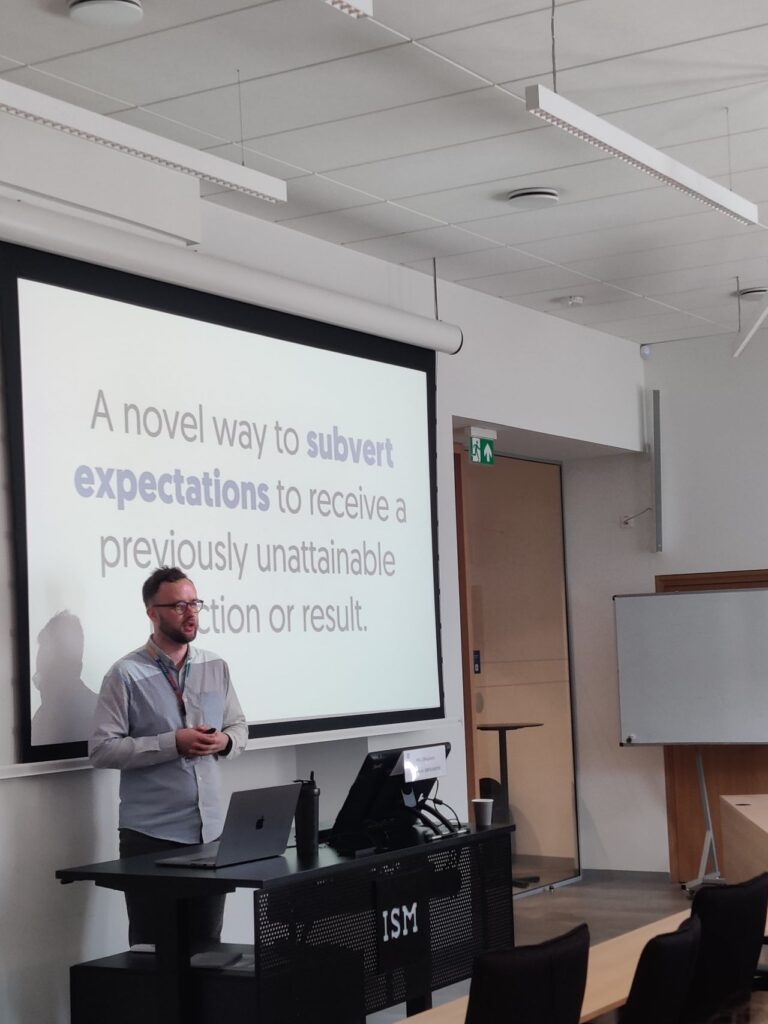
At ISM University of Management and Economics, I teach two courses. Fundamentals of Web and App Design takes undergraduate students from zero to functional — covering HTML, CSS, JavaScript, and e-commerce implementation in a single semester, with enough real project work that the learning does not evaporate the moment the exam ends. The student rating has held at 4.79/5.0, which I find more interesting than flattering, because a rating that high usually means something specific about what students are responding to. In this case, I think it is the refusal to pretend that any of it is easy.
The second course is Continuous Business Development Project III and IV — which is the kind of name that hides a very good idea. Student teams work through the full arc of moving an idea from a napkin sketch to a functional prototype, with mentorship at every stage. I run workshops, I challenge assumptions, and I try to be the person who asks the question the team is hoping no one will ask. That is, apparently, useful.
Lithuania’s Largest Vibecoding Hackathon
In November 2025, ISM hosted something that had never happened in Lithuania before — a five-day vibecoding hackathon that brought together 170 students from 12 universities across Lithuania, Germany, Latvia, Belgium, and India. Zero traditional coding. Functional applications. Built entirely through natural language and AI tools.
I served as a preselection judge and mentor throughout the event. What made this one different from a typical hackathon — and genuinely surprising even to me, having spent years thinking about education and technology — was the composition of the participants. Business administration students. Marketers. Physiotherapists. Sports scientists. People who had never imagined themselves as builders, shipping working products by day three.
The winning project, FocusAI, was a virtual focus group tool that let founders test product ideas against AI-simulated consumer personas that actually debated each other. The entire backend was built in a day and a half. The third-place team — two practicing physiotherapists — built an automated rehabilitation exercise program generator that kept the specialist in the loop. None of the top teams came in with a technical background.
This is the thing I keep coming back to: the barrier between having an idea and being able to test it has collapsed. What used to require months of learning or a co-founder with a computer science degree now requires clarity of thought and a willingness to iterate. That is a genuinely new condition for entrepreneurship education, and most curricula have not caught up to it yet.
ISM is planning a larger edition next year. I plan to be involved.
Full ISM writeup on the event.
Selected student projects